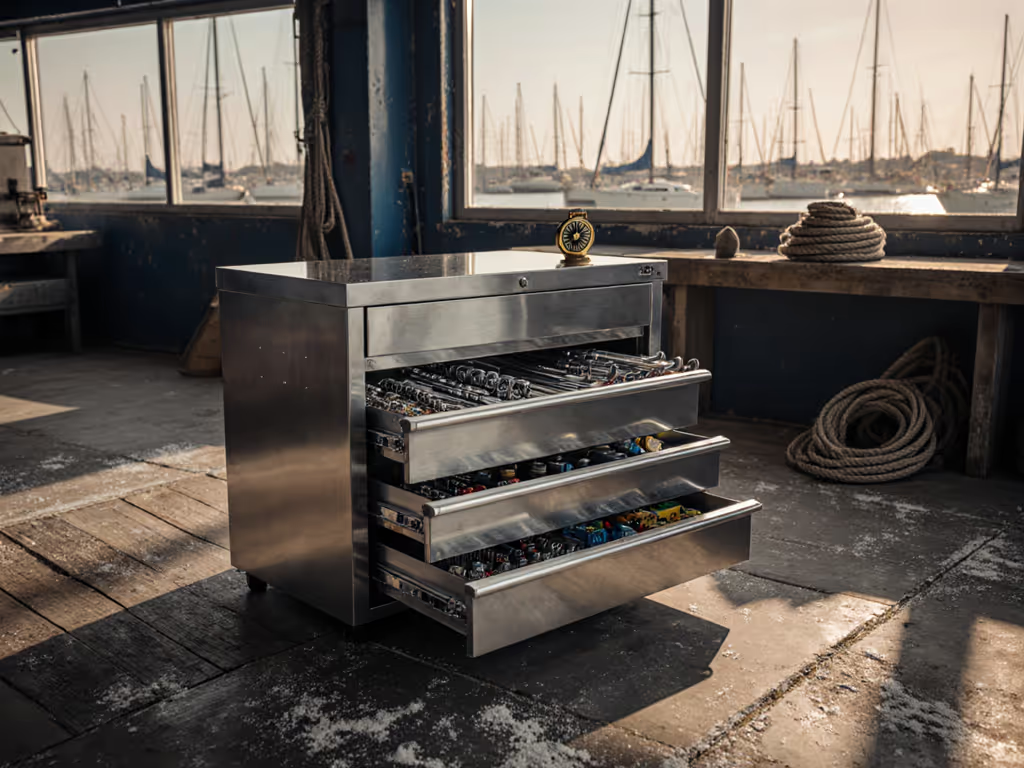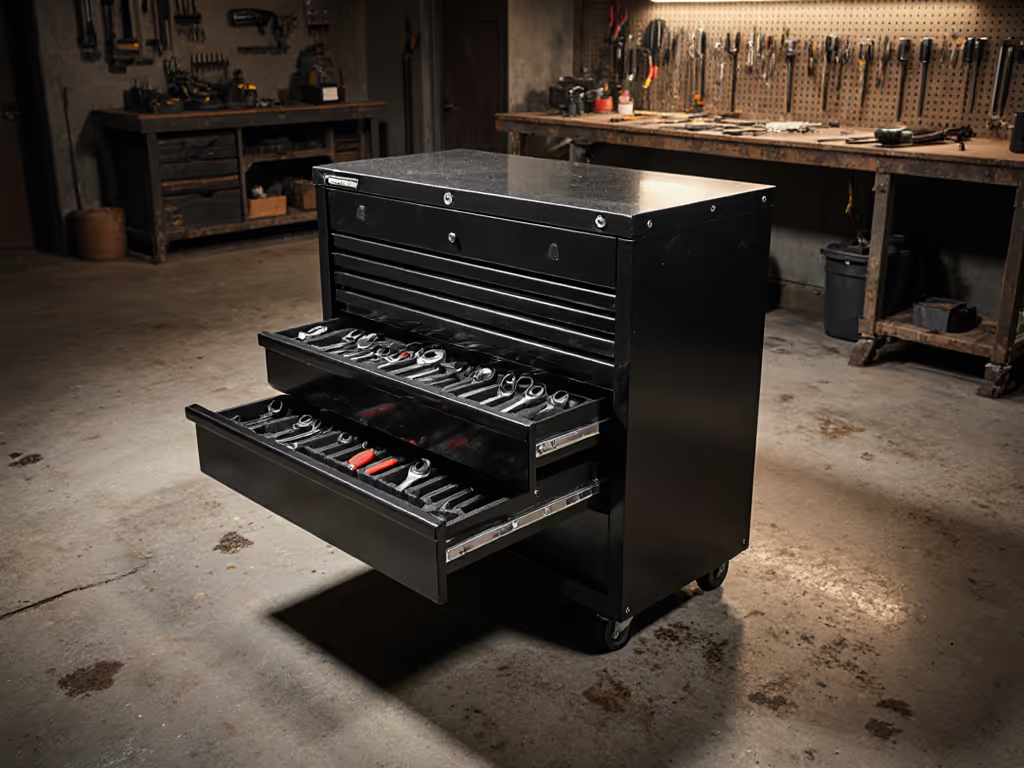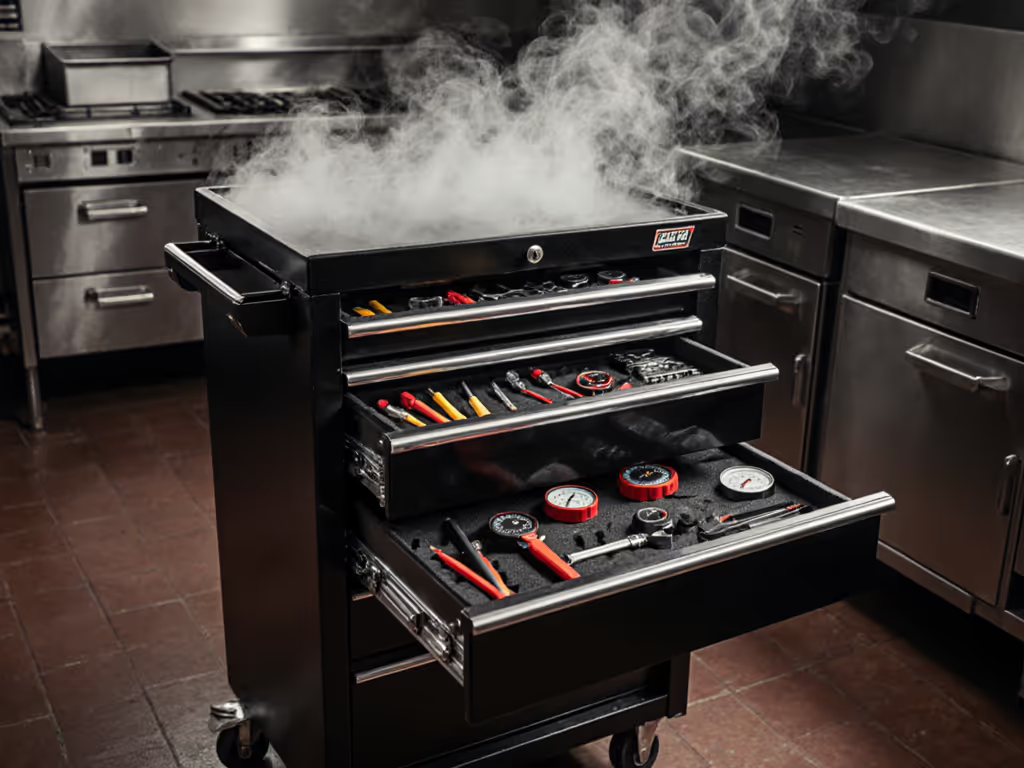

Truck Tool Storage for Knife Makers: Speed Over Capacity
By Aisha Khan • 19th Mar
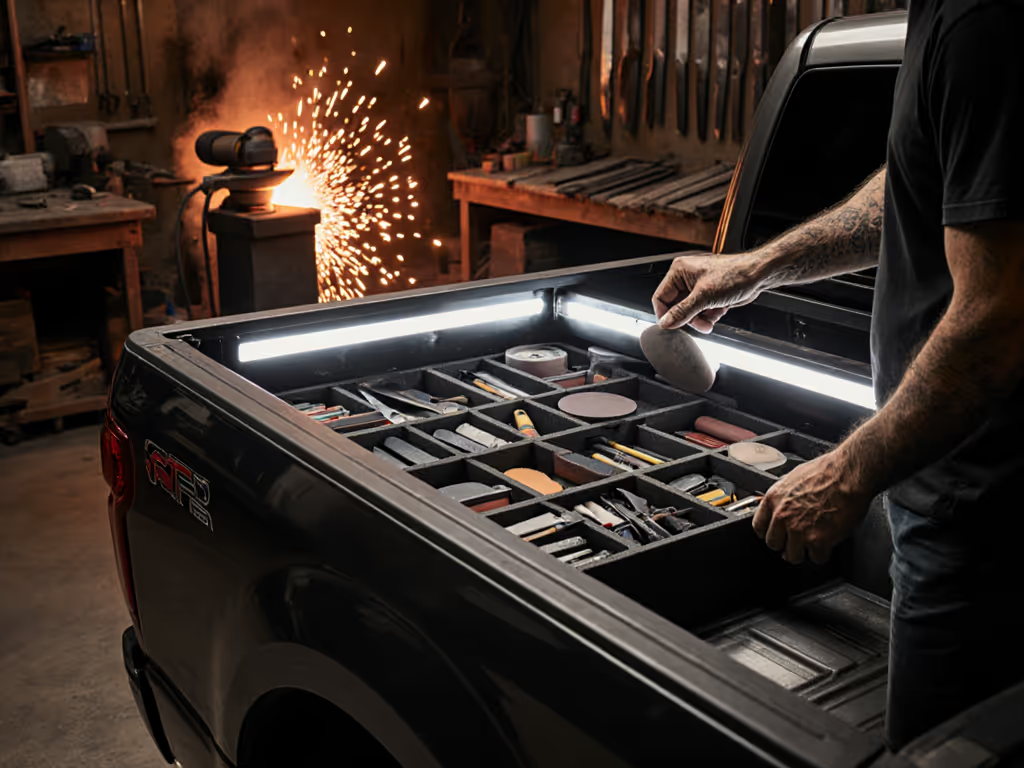
When a custom blade hits deadline and your sharpening stone vanishes into a nested pile of knife blanks, a truck tool box stops being storage. It becomes a production bottleneck. Most truck tool storage boxes are designed for wrenches and drill bits, not the precision retrieval workflows that knife makers demand. Yet the right box, configured for throughput instead of volume, cuts seconds from every grind and measurement cycle. That margin compounds. Over a month of production runs, proper layout transforms a search-and-fetch chaos into a repeatable, measurable system.
I learned this the hard way. A late-night rush to locate a 10mm socket taught me something that applies equally to blade blanks: the stopwatch never lies. For knife makers managing professional sharpening organization in mobile setups, this principle scales sharply. Every second spent hunting for a stone or caliper is a second your bench sits idle.
The Core Problem: Truck Boxes Were Not Designed for Precision Work
Standard truck tool boxes prioritize capacity over access velocity. They stack deep, assume you know roughly where something is, and rely on visual scanning across jumbled drawers. This works fine for a construction crew throwing in a nail gun and a level. It fails for knife makers who juggle dozens of similar-looking blanks, multiple grit stones, precision measurement tools, and sharpening supplies that demand one-motion retrieval.
Most crossover and bed-mounted boxes on the market today lack the drawer segmentation, full-extension slides, and labeling infrastructure that precision work demands. They ship with open compartments or shallow dividers that guarantee the junk-drawer effect within a month. A blade template gets buried under a 1000-grit stone. Calipers fall sideways. Heat-treat blanks mix with finished stock.
The trade-off is real: if you buy a box with the depth to store long blanks, you sacrifice quick top-layer access to frequent-reach items like sharpening compound or marking gauges.
Measuring the Penalty: Retrieval Time and Throughput Impact
Let's frame this in concrete terms. A knife maker performing repetitive edge-work cycles (blank selection, stone application, angle verification, cool-down) ideally completes the retrieval phase (finding stone, measuring tool, template) in under 15 seconds. Call this the reach window. If the average search extends beyond 20 seconds, your effective throughput drops 10-15% per shift. Over a 40-unit weekly production run, that penalty compounds to hours of lost capacity.
The solution is not more space; it is organized access. A drawer mapped by tool type and frequency, with foam inserts or dividers, cuts that retrieval time to under 8 seconds. Quiet, full-extension slides let you grab a stone mid-drawer without tipping the box. Gas-strut lids that hold open keep your hands free. A label that survives solvent wipe-downs (laser-etched, not printed) eliminates the "where did I put that" moment.
These are not luxury add-ons. They are production-rate enablers.
Label it or lose it, and when you lose precision tools, you lose time that your invoice cannot recover.
Comparing Truck Tool Box Platforms Against Knife-Making Workflows
Crossover Boxes: The Shallow-Access Trade-Off
Decked Tool Box and Craftsman Aluminum Crossover models dominate the mid-range segment because they balance truck-bed foot-print with ease of installation. The Craftsman Crossover, for example, sits low-profile with nine cubic feet of storage, dual gas springs for smooth opening, and powder-coat finish that resists corrosion in a mobile workshop. Installation is drill-free and takes under an hour on most truck beds.
For knife makers, the critical metric is effective drawer depth. Crossover boxes typically measure 48-52 inches wide and 18-22 inches front-to-back. That footprint works if you're storing blade blanks horizontally and sharpening supplies in the shallow end. But the lid opens as a single assembly, meaning you cannot grab a top-layer stone without exposing the entire box contents. In a windy mobile setup or a shared workshop, that matters. Dust ingress becomes real. Organization degrades faster.
Verdict: Crossover boxes suit knife makers with limited bed space who can accept a secondary storage tier. They excel at toolbox-under-tonneau-cover scenarios where space premium is high. For primary blade-blank and stone organization, the shallow drawer architecture creates unnecessary retrieval friction.
Modular Stackable Systems: Makita MAKTRAK and Horizontal Spreading
Makita MAKTRAK represents a newer philosophy: horizontal spreading rather than vertical stacking. The system uses a wide, flat base that accommodates multiple box sizes, double-sided entry lids, and oversize latches tuned for outdoor-job environments. Makita designed MAKTRAK to slide under a tonneau cover without disassembly, a real win for mobile knife makers who tow their shop between locations.
The horizontal strategy also matters for precision-tool organization. Instead of a single deep drawer, you get multiple compact boxes that sit side-by-side. This modular approach lets you dedicate one box strictly to blanks, another to stones and honing supplies, and a third to measurement and layout tools. Each box carries only its category, reducing search time and preventing tool-type contamination.
The trade-off: MAKTRAK costs more upfront than a single crossover box. The lower steel gauge (compared to Weather Guard industrial units) means it dents more easily if tools shift during transport. To prevent damage and lost time, follow our tool chest transport guide for securing drawers and cargo on flatbeds. But for a knife maker whose most-used items fit into separate 15-20-inch cubes, the modularity justifies the price premium. You can add or swap boxes as your blade-blank inventory grows.
Verdict: MAKTRAK suits professional knife makers running mid-scale operations (20-50 blades per week) who value expandability and clean category separation. The horizontal footprint is ideal for truck-bed workflows. Durability is adequate for tool-only storage; do not expect it to absorb repeated impact from heavy blank shipments.
Heavy-Duty All-Steel: Weather Guard and Commercial-Grade Rigidity
Weather Guard Crossover Tool Box sits at the premium end, with all-steel construction, gas-shocks, and commercial-fleet compatibility. These boxes are engineered for construction sites where theft, weather, and daily abuse are real hazards. They weigh significantly more than aluminum alternatives and come with a U.S. lifetime warranty.
For a knife maker running a registered shop or managing tool control in a high-value operation, Weather Guard's security architecture (keyed-alike systems, optional remote locks, fleet-ready audit trails) is a genuine advantage. For deeper insight on lock quality, see our locking mechanisms comparison. The rigid steel construction also handles repeated blade-blank loading without flexing or cracking dividers.
The penalty is weight and mobility. A full Weather Guard box can exceed 150 pounds empty and absorbs 500+ pounds of payload. If your truck setup is mobile and frequent, the labor cost to load and unload that box eats into your advantage. Caster selection and truck suspension become critical.
Verdict: Weather Guard is overkill for most independent knife makers but essential for shops managing tool accountability, insurance compliance, or multi-tech coordination. If you are a solo maker working from a single truck, the extra durability does not translate to faster retrieval. Stick with mid-tier aluminum unless security or fleet standardization is a hard requirement.
Narrow-Profile Options: Dee Zee Specialty Series and Short-Bed Reality
Modern trucks (especially 4-door crew-cabs) ship with 5.5-foot beds, leaving minimal space for a full-width tool box. Dee Zee Specialty Series Narrow Crossover (15 inches front-to-back) solves this by narrowing front-to-back depth while maintaining full width. This is a smart design for knife makers who also haul finished blades, raw materials, or customer orders in the same bed.
The trade-off is obvious: 15 inches of front-to-back depth forces you to make hard choices about what lives in the box and what stays on a mobile cart or secondary bench. Frequent-reach items (stones, calipers, marking gauges) can live in the narrow box; bulk blank storage shifts to a separate container or internal frame system.
For makers in tight urban workshops or those towing trailers, the narrow profile is practical. But it requires discipline and labeling to prevent the inevitable drawer creep where everything slowly migrates into the box, defeating its purpose.
Verdict: Dee Zee Specialty works for knife makers with short beds and tight integration requirements. Pair it with a mobile cart for secondary storage to avoid overloading a 15-inch profile. The aluminum construction dents easily under blade-blank impact, so avoid stacking heavy items vertically.
Fixed Shop Chest Systems: Husky and the Stationary Advantage
Most truck tool boxes assume mobility. But if your knife-making primary workspace is a fixed shop and the truck serves as a mobile extension, a Husky 52-inch tool chest and cabinet combo offers dramatically better throughput economics. At $10,000+ less than Snap-On equivalents, Husky delivers durable ball-bearing slides, deep drawers with usable full-extension capability, and a footprint that integrates with standard foam-insert systems.
The advantage here is repetitive precision retrieval. When your bench is fixed and your muscle memory is honed, a stationary chest with labeling and category mapping drives your reach window down to 5 seconds. The truck then becomes a restocking platform: you load blanks and stones into the truck box during a job, work from the truck, and restock the fixed chest at the end of the day.
This dual-system approach sounds like overhead, but it cuts down total box complexity. Your truck box only needs to hold 1-2 days of active work; your fixed chest holds your full inventory, organized by heat-treat status, blade profile, and edge-finish stage.
Verdict: A Husky chest is not truck storage; it is a workshop anchor. But for knife makers who can separate mobile work from fixed production, the fixed chest becomes your throughput engine, and the truck box becomes your delivery vehicle. This mental model reframes the problem: truck storage does not need to do everything.
The Speed-Capacity Trade-Off: What Knife Makers Actually Need
Here is where skepticism serves you. Every toolbox review on the market emphasizes capacity: cubic feet, payload weight, how many hammers fit inside. That metric is noise for precision work. Your sharpening stone weighs ounces. Your blade blanks, dozens of pounds total. Actual payload for a full production shift is probably 30-40 pounds, not 200.
What matters is layout repeatability. Can you map every tool to a named drawer slot and rebuild that map across trips? Will your labeling survive a solvent wipe? Do full-extension slides guarantee you reach the back of the drawer without tipping? These questions drive throughput; capacity does not.
Most knife makers overbuy storage by a factor of 3-4x. Then they underfill it, leaving air gaps that create movement and hiding spots. A smaller, properly segmented box with dedicated foam or dividers beats a half-empty warehouse on wheels.
Practical Benchmarks: Measuring Your Setup
- Reach time: Clock yourself grabbing your most-used sharpening stone from your current setup. If it is over 12 seconds, your current system is a bottleneck.
- Visual search: Count how many drawer-opens you need before you locate a blade template or caliper. Anything over one open is a failure.
- Drawer utility: Estimate what percentage of your box depth actually holds tools you use weekly. If it is under 60%, you are overbuying capacity.
- Labeling durability: Mark a drawer with a permanent marker. Wipe it with shop solvent. If the label smudges, your system will degrade within a month.
- Load cycling: Load your truck box for a full day of work. How many times do you open the main lid? If more than twice, your access layout is fighting you.
These five metrics will tell you whether you need a bigger box or a better-organized smaller one. Most knife makers discover they need the latter.
Configuration Principles for Precision Tool Organization
Dedicate tiers by frequency. Top drawer: sharpening stones, measuring tools, marking gauges (items you touch every cycle). Middle drawer: blade templates, finishing supplies, secondary tools. Bottom: bulk blade blanks, heat-treat inventory. This spaghetti-diagram approach maps your motion, not your storage capacity.
Use foam inserts or divisible trays for everything. Open compartments are planning failures. Each tool needs a named shadow home. Over time, your team (if you have one) or your own muscle memory will treat the layout as gospel. Consistency across setups, even if you own multiple trucks, is where speed compounds.
Label it or lose it. Laser-etched labels on drawers, not printed stickers. Your workshop is not an office; solvents, heat, and humidity destroy printed labels within weeks. Etched labels survive indefinitely and signal a professional operation.
Pair the truck box with a fixed restocking point. Your primary knife-making bench should have a secondary cart or small chest that mirrors the truck-box layout. This reduces cognitive load when switching between fixed and mobile work.
Plan for thermal management. If you store cordless batteries or heat-treat blanks in the truck box, ensure the lid vents and you avoid sealed, hot cabins in summer. For heat and humidity prevention best practices, use our climate-controlled tool storage guide. A gasket that seals out dust is good; a sealed box that traps heat near lithium batteries is a liability.
The Final Verdict: Speed Beats Everything Else
After reviewing the current truck-box landscape, the verdict is clear: pick a mid-tier modular or crossover system (Craftsman, Makita MAKTRAK, or Dee Zee), commit to foam-insert organization, and spend your money on labels and measurement discipline, not extra storage.
Do not buy a heavy-duty Weather Guard unless you are running a fleet or managing high-value security. Do not assume bigger is better; 40% of your truck-box volume will sit empty within two years as you learn what you actually use. Do not try to run your entire operation from the truck; use a fixed chest for inventory and the truck as a mobile restocking platform.
The stopwatch says the layout works; the clock never lies. The knife maker who can retrieve a stone, measure an angle, and mark a blank within 10 seconds maintains a rhythm that compounds over a 40-unit production week. That rhythm is not a luxury. It is the margin between making deadline and missing it.
Start with a $300-500 crossover box, map it ruthlessly, and measure your cycle time. After two weeks, you will know whether you need to upgrade or downsize. Spend three weeks optimizing drawer layout before you consider spending more money on storage. Layout beats horsepower when deadlines loom, and for precision-tool workflows, layout is all that matters.
Related Articles